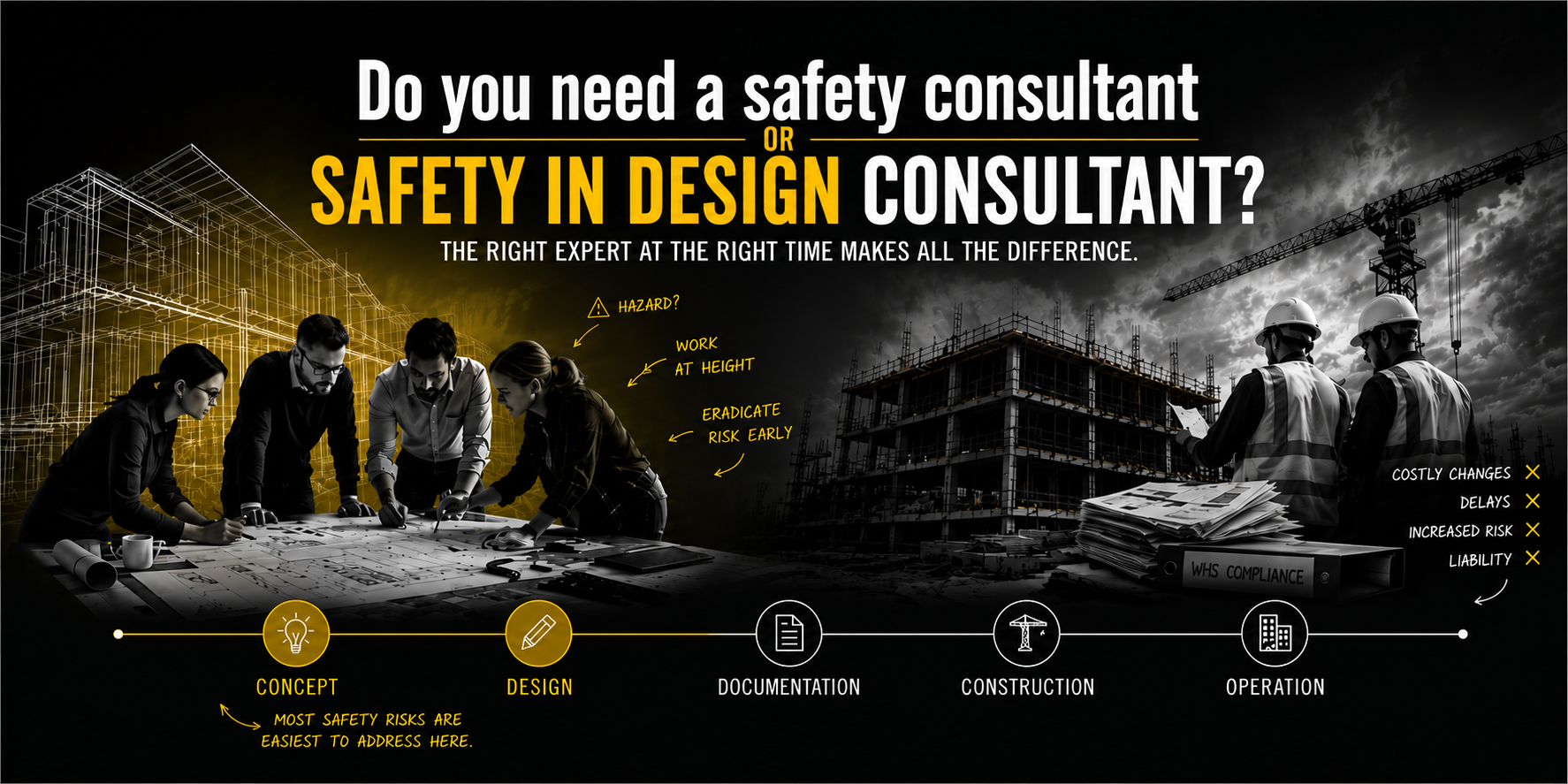
Many people searching for a safety consultant are actually dealing with design risks that are best addressed by a Safety in Design consultant.
If you’re searching for a safety consultant, you’re not alone. It’s one of the most common terms people use when trying to manage risk on a project.
But here’s the problem:
Most people searching for a “safety consultant” are actually dealing with risks that should have been addressed during design — not on-site.
And that’s where the distinction matters.
Why Timing Matters
Early design decisions shape how safe a structure will be to build, use, maintain and eventually decommission. Yet many designers only think about engaging safety support once drawings are nearly final — or after construction has already started and unexpected risks emerge.
By that stage, design-related risks may already be influencing the project in ways that are difficult to reverse.
And while safety consultants, safety managers and WHS specialists play a critical role in risk management and abatement, a specialised Safety in Design consultant works at a completely different stage of the project — helping teams identify and manage risks before they become locked into the design.
Safe Design Australia (SDA) regularly supports designers, safety consultants, safety managers and project teams by leading or advising on Safety in Design processes, providing specialist WHS design-phase knowledge, providing documentation such as Safety in Design reports, and strengthening the long-term safety performance of projects.
New to the concept? Here’s a practical overview of what Safety in Design actually means and why it matters.
By the end of this article, you’ll understand:
- the difference between a safety consultant and a Safety in Design consultant
- when each is most valuable
- the key moments to engage a Safety in Design consultant
- and how early Safe Design thinking can reduce downstream rework while supporting smarter, safer and more elegant project outcomes
What’s the difference between a Safety consultant and a Safety in Design consultant?
Safety consultants and safety managers typically support onsite WHS systems, contractor safety, compliance, audits and operational controls. Their focus is usually construction-phase or operational-phase risk.
What most people mean when they search for a “safety consultant” is:
- site safety and inspections
- WHS compliance during construction
- incident prevention and management
- safety systems and procedures
This work is critical — but it usually happens after key design decisions have already been made. At that point, many risks are already built into the project.
A Safety in Design consultant works at a completely different stage of the project. Instead, a Safety in Design consultant helps project teams eliminate or reduce risks during the design phase before anyone builds, uses or maintains the structure.
This includes:
- Identifying hazards early in the design process
- Running structured Safe Design workshops (e.g. the CHAIR process — read about it HERE)
- Supporting designers to meet WHS duties
- Producing Safety in Design reports
- Ensuring risks are addressed so far as reasonably practicable
In short: A safety consultant supports safe work.
A Safety in Design consultant supports safe design.
This is not reactive safety management.
This is upstream risk reduction through design.
Why the Difference Matters
Importantly, under Australian WHS legislation, designers have a legal duty to ensure, so far as reasonably practicable, that the structures they design are safe.
That means:
- Risk should be addressed before construction begins
- Not just managed on site
- Not just documented after the fact
If these risks are missed during design, they often become:
- More expensive
- Harder to fix
- Higher-risk
Safety Consultant vs Safety in Design Consultant
| Safety Consultant | Safety in Design Consultant |
| Site-based | Design-phase |
| Reactive | Proactive |
| Focus on compliance | Focus on risk elimination |
| After design | During design |
| Manages risk | Reduces or eliminates risk |
Timing matters: the cost of bringing in Safety in Design support too late
Most safety issues don’t “appear” onsite. They originate months earlier in design.
Importantly, when risks are identified late — during tender, construction or after occupation — the consequences often include:
- expensive redesigns
- structural or services changes
- delays to construction
- increased WHS liability
- loss of design integrity
- missed opportunities to improve design outcomes during early design stages
Late-stage changes often force safety consultants and project teams to manage issues that could have been addressed earlier through Safety in Design review. Once documentation is locked in, there is far less flexibility to explore safer or more efficient alternatives.
Designers already carry significant WHS duties under Australian legislation. Early support from a Safety in Design consultant helps teams meet those obligations with greater clarity and less downstream stress.
Here’s a good read on how Safe Design supports creative design outcomes
4 key moments when you should engage a Safety in Design consultant
Timing makes the difference between a smooth, well-documented process and reactive project problem-solving. Here are the clearest triggers:
1. At concept design
Early decisions shape construction access, maintenance methods, cleaning systems, fall prevention and future operational safety. This is often where a Safety in Design consultant can provide the greatest value.
2. Before completing schematic or design development
As details firm up, risks can quietly become built into the design process. As design progresses, a structured Safety in Design review helps teams refine decisions before modifications begin affecting programme, coordination or buildability.
Typical focus areas include:
- maintenance access
- cleaning and façade systems
- plant and equipment locations
- fire and egress considerations
- material and lifecycle considerations
3. When the design changes significantly
Changes in form, materials, structure, services, staging or client requirements can all introduce new risks.
A short, specialist SiD review helps ensure the design continues to meet WHS duties while identifying new risks early.
4. When new risks, technologies or stakeholder needs emerge
This includes:
- façade systems
- construction methodologies
- sustainability features
- innovative materials
- operational requirements
- changing user groups or occupancy patterns
Importantly, early Safety in Design input helps teams identify emerging risks before they begin affecting construction, operations or long-term maintenance outcomes.
When Does a Safety in Design Consultant Add the Most Value?
A Safety in Design consultant is particularly valuable for:
- complex or high-risk projects
- new building types or innovative construction approaches
- sustainability-driven features or emerging technologies
- major design changes
- tight cost, design or regulatory constraints
Safety in Design support is especially helpful when:
- design teams are stretched or under time pressure
- newer designers are leading projects
- safety managers need design-phase support
- there is uncertainty around WHS duties or documentation
A real example: sustainable design and unexpected risks
Sustainability-led buildings often introduce innovative façade systems, green walls, integrated landscaping and new material behaviours. While these systems can create exciting design opportunities, they can also introduce complex lifecycle and maintenance considerations.
Sydney’s One Central Park illustrates the importance of aligning innovative systems with long-term lifecycle planning, maintenance access and operational performance.
Beyond the widely reported 2023 façade incident involving a falling planter box, investigations revealed broader issues including:
- flammable cladding rectification
- drainage and moisture issues within the green wall system
- corrosion of structural steel
- complex long-term maintenance requirements
- significant rectification costs
Media reporting and industry commentary surrounding the project highlighted how innovative systems can introduce unforeseen operational and maintenance challenges over time.
This is not a criticism of innovation. The more ambitious and sustainable a design becomes, the more important early Safety in Design review and lifecycle planning become in supporting safe and durable operation over time.
Summary & Next Steps
Ultimately, specialised Safety in Design reviews identify risks earlier, creating greater opportunities to improve safety, constructability and operational performance. As a result, projects are more likely to achieve smarter, safer, more elegant and enduring outcomes.
To explore how Safe Design Australia can support your project:
👉 Book a Safety in Design Workshop
👉 Request a Safety in Design Report
👉 Explore our templates, tools and online courses
👉 Talk through your project’s Safe Design priorities with our team
FAQs
When should I engage a Safety in Design consultant?
Ideally, engage a Safety in Design consultant at concept stage, and then revisit the process at key design milestones or whenever major changes occur.
Does engaging a safety consultant help with WHS compliance?
Under WHS legislation, designers have a duty to ensure, so far as reasonably practicable, that structures are safe. A Safety in Design consultant helps designers meet these obligations.
Is a Safety in Design report required for all projects?
No. A formal Safety in Design report may not be needed for every project. However, the Safe Design duties themselves are mandatory for all designers, regardless of project size or type.
Is a Safety in Design workshop mandatory?
Not explicitly. However, the underlying WHS duties absolutely are. In practice, project teams use workshops to identify and control risks early, demonstrate compliance with consultation and cooperation duties, and document key design decisions.