WHS LEGISLATION IN AUSTRALIA
Safe Design Australia makes WHS legislation easy to understand through our services, our fact sheets and Safe Design in Practice eBook.
Our staff can assist you in interpreting and fulfilling WHS legislation in Australia, no matter where you are located.
Designers must provide information on how they have designed the structure to be without risk to health and safety to anyone who is issued with the design.
NATIONAL HARMONISATION OF WHS LEGISLATION
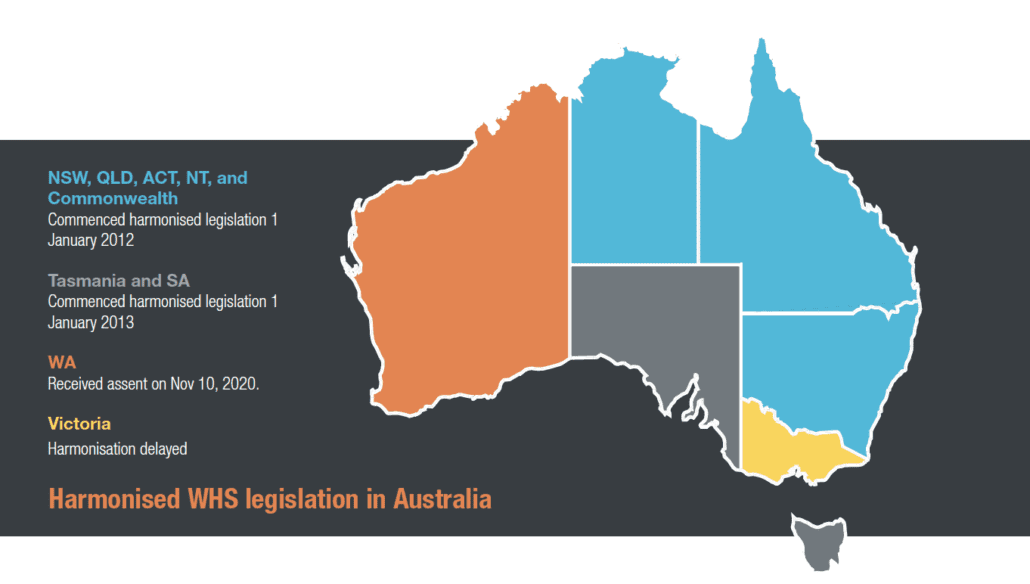
The harmonisation of work health and safety (WHS) legislation was proposed to reduce regulatory burdens, protect the health and safety of workers and workplaces, reduce the compliance costs for business and improve efficiency of regulators. WHS legislation has been enacted in seven jurisdictions including the Commonwealth, New South Wales, Queensland, Northern Territory, Australian Capital Territory, South Australia,Tasmania and Western Australia. Victoria has yet to enact the legislation (although Victoria does have safe design obligations). State and territory regulators are responsible for adopting and enforcing their own laws. Safe Design Australia can assist you with meeting your safe design obligations in all states and territories.
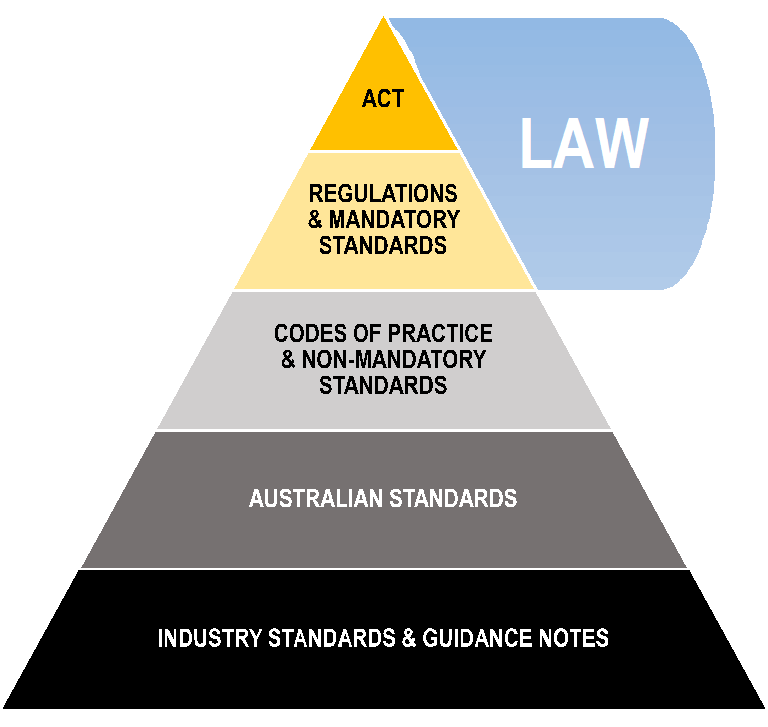
WHS legislation pyramid
Elements of the WHS legislation and how they all fit together.
WHAT DOES THIS MEAN FOR DESIGNERS?
Duties of the designer under the WHS legislation
Under section 22 WHS Act
The designer must ensure structures are designed to be safe when it is used as a workplace during its lifecycle. This includes during the construction of the structure, the use for purpose for which the structure is designed, the maintenance, cleaning or repair of the structure and the eventual demolition at end of life. Designers must also consider the safety of people in the vicinity of the workplace.
There are two specific requirements for designers to provide information, one under the WHS Act and the other under the WHS Regulation.
Under section 22(4) and 22(5) WHS Act, the designer must provide information to anyone who is issued with the design, indicating the purpose for which the structure is designed, the results of any testing and analysis undertaken and any conditions necessary to ensure that the designer has designed the structure to be without risk to health and safety when it is used as a workplace during its lifecycle. Current relevant information must also be provided to people who use, construct, maintain or demolish the structure on request.
WHS Regulation 295 requires the designer to provide the PCBU client with a safety report outlining potential hazards unique to that design that may pose a hazard to people carrying out construction work, having regard to relevant WHS policies and procedures.
WHAT DOES THIS MEAN FOR CLIENTS
Duties of the client under WHS legislation in Australia
The Code of Practice: Safe Design of Structures refers to a person conducting a business or undertaking (PCBU) who commissions a design, construction work or a construction project as ‘the client’. The client has specific duties in relation to the safe design of structures.
Under section 26 WHS Act, the client has duties to ensure that they commission structures that are without risk to health and safety for workers throughout their lifecycle as a workplace. They must also consider those in the vicinity of the workplace.
WHS Regulation 294 and 296 places further obligations on the client to consult with the designer on how risks to health and safety can be eliminated or minimised. The client must also provide the principal contractor with any information that they have in relation to the hazards or risks at, or in the vicinity, of the workplace where the construction work is being carried out. This would include providing the principal contractor with the designer’s safety report.
WHAT DOES THIS MEAN FOR PRINCIPAL CONTRACTORS
Duties of the principal contractor under the WHS legislation
A principal contractor is required for a construction project where the value of the construction work is $250,000 or more. The Safe Work Australia’s Code of Practice: Safe Design of Structures states that the principal contractor has duties to ensure that the construction work is planned and managed in a way that eliminates or minimises health and safety risks so far as is reasonably practicable. The client can be the principal contractor or the client can engage a principal contractor (builder) to discharge their duties as a principal contractor. The principal contractor must prepare a WHS management plan where the value of the construction work is $250,000 or more.
A principal contractor may also be a designer if they undertake design work or if they alter or modify a design without consulting the original designer. Principal contractors must ensure that any changes they make to the design do not create additional risks to health and safety.
DESIGNER
- Consider safety throughout lifecycle as workplace.
- Consult with client, workers, principal contractor and other duty holders.
- Consider people in vicinity.
- Undertake research, testing and analysis.
- Provide Safe Design Report on construction hazards to client.
- Provide Safety in Design information on the structures lifecycle to anyone issued with the design and on request.
CLIENT
- Consider safety throughout lifecycle as workplace.
- Consult with designer, workers, principal contractor and other duty holders.
- Consider people in vicinity.
- Provide information to designer.
- Provide information to principal contractor on safety including designer’s Safe Design Report.
PRINCIPAL CONTRACTOR
- Required for a construction project where the value of the construction work is $250,000 or more.
- Ensure construction work is managed in a way that eliminates or minimises risk to health and safety.
- Consult with other duty holders.
- Manage risks associated with the construction work.
- Secure the workplace.
Comply with all Safe - Work Method Statements for high risk work.
- Must comply with duties of designer when undertaking design work or modifying a design.
Safe Design Australia can assist you with Safe Design Reports, or provide training for you and your organisation on how to meet your Safety in Design obligations.
CONSULTATION,
COOPERATION AND
COORDINATION
Duties to consult under the WHS legislation
Section 46 and 47 WHS Act, make it a legal requirement for people with duties under the WHS Act to consult with each other and also to consult with workers or their WHS representative.
Consultation is an important process in which people with knowledge and expertise work together to share information, identify hazards and assess risks and make decisions about ways to eliminate or minimise those risks. Consultation can assist in identifying design solutions to issues that may affect the safety of workers. Consultation can involve meetings, discussions, workshops, and sharing of knowledge or information.