
When we think about CPTED and crime prevention, our minds tend to jump to cameras, locks, fences and security guards. But some of the most effective crime prevention happens much earlier — at the design stage.
Crime Prevention Through Environmental Design (CPTED) uses the planning, design and management of built and natural environments to reduce opportunities for crime and create places where people feel safer.
But CPTED has another, more interesting side.
Good CPTED doesn’t only consider how to keep the wrong people out. It asks how good design can bring the right people in.
Places that encourage people to walk through them, meet, linger, work, shop, play and connect generate legitimate activity. That activity creates natural surveillance and, over time, something even more valuable: connection, ownership and custodianship.
So while CPTED is about designing out crime, at its best it is also about designing community in.
What is Crime Prevention Through Environmental Design?
CPTED starts with a deceptively simple idea: the way we design and manage a place can influence what happens there.
Building orientation, entrances and exits, landscaping, lighting, sightlines, pathways, boundaries and the activities attracted to a space can all influence behaviour and perceptions of safety.
The Queensland Police Service Crime Prevention Through Environmental Design Guidelines for Queensland 2021 describe CPTED as a well-researched crime prevention method and encourage its integration into the planning, design and management of public spaces.
Importantly, the guidelines also challenge the idea that safer automatically means more fortified. Public spaces and buildings still need to meet the physical, social and economic needs of their communities.
You can put a two-metre fence around everything, cover it in cameras and control every entrance. Very secure. Also, possibly a prison..
Good crime prevention through design looks for something smarter: environments that discourage unwanted behaviour while remaining attractive, intuitive and welcoming to legitimate users.
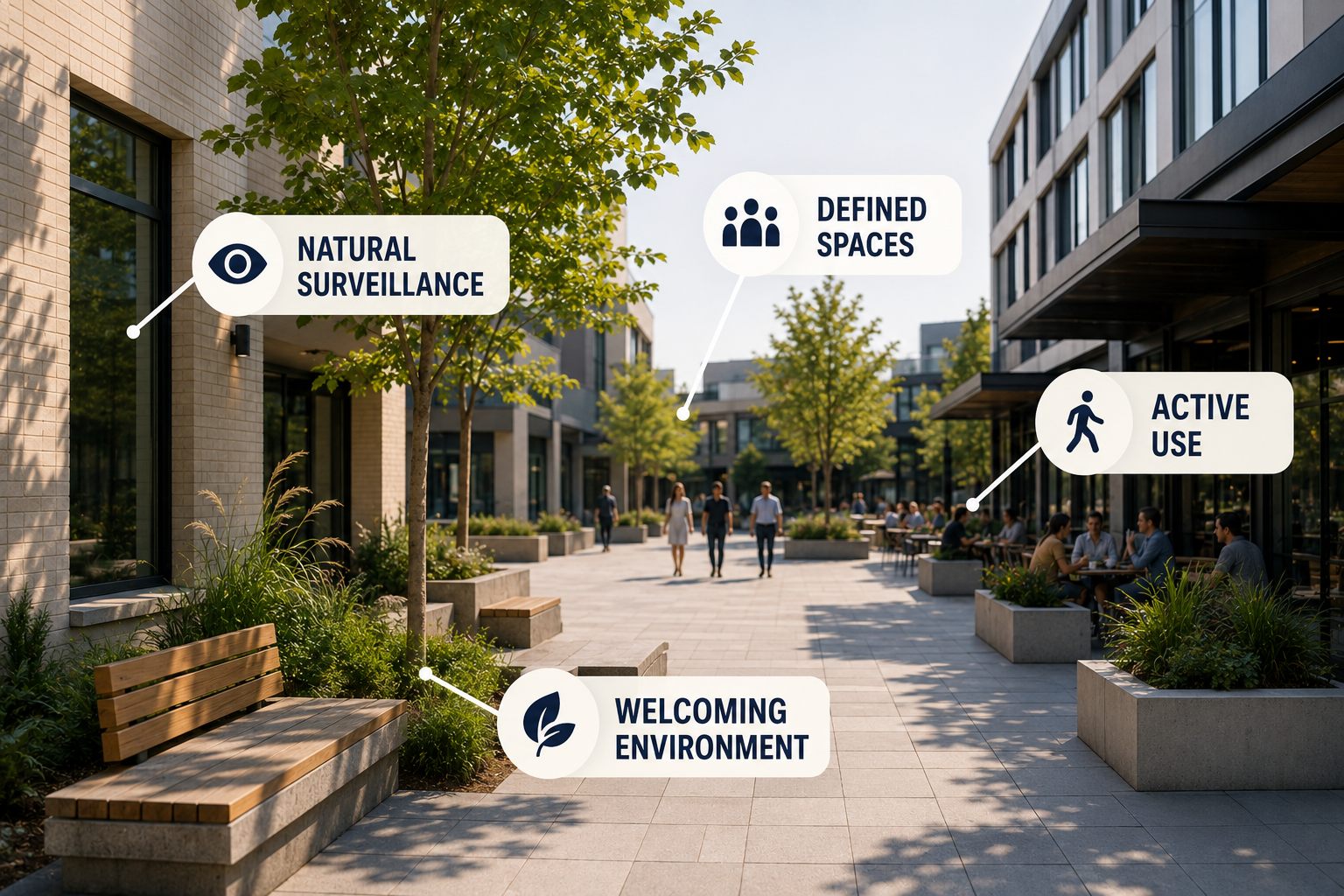
What are the key principles of CPTED?
Search for the principles of CPTED and you’ll probably encounter three, four or even seven.
That’s not necessarily a contradiction. CPTED has evolved over time, and different Australian jurisdictions organise its principles somewhat differently.
The NSW Police Safer By Design framework identifies four key CPTED strategies:
- Territorial reinforcement — creating a sense of ownership and guardianship.
- Surveillance — helping people see and be seen.
- Access control — using design to guide people towards appropriate routes and spaces.
- Space and activity management — encouraging appropriate use, care and maintenance.
Good CPTED also relies on ongoing maintenance — places that look cared for tend to attract care, while places that look neglected tend to attract neglect.
Queensland’s 2021 guidelines take a broader approach, identifying seven principles: activation, surveillance, ownership, stakeholder management, legibility, territoriality and vulnerability.
Some overlap with the NSW strategies, but several broaden the thinking. Activation considers how a space attracts legitimate activity and people. Stakeholder management brings the people who design, own, operate, manage and use a place into the crime-prevention conversation. Legibility is about making an environment easy to understand and navigate. And vulnerability asks where a place, its users or assets may be particularly exposed to crime — so the design can respond to the actual risk rather than applying generic security measures.
Different terminology, but a consistent idea: understand the place, its users and crime risks, then use thoughtful design, activation and ongoing management / maintenance to reduce those opportunities. Well-maintained places also signal care and reinforce ownership and guardianship.
CPTED isn’t a formula or a checklist. Context matters.
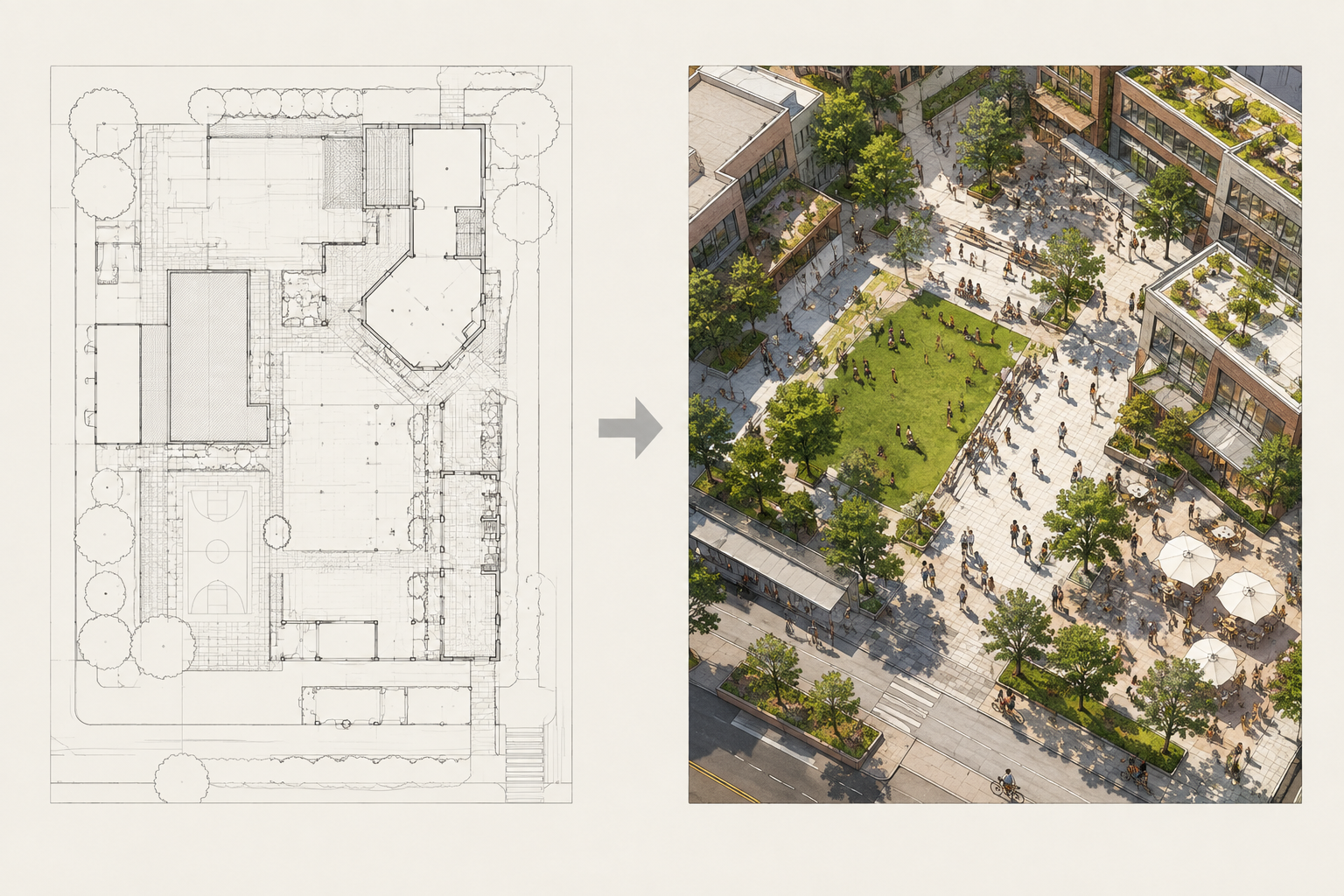
What does CPTED actually look like in a design?
Sometimes the answer is surprisingly simple.
An entrance placed where people naturally observe it. Landscaping that looks beautiful without creating hiding places. Lighting that makes the route home inviting after dark. Windows overlooking a public area. A clear, obvious path through a complex site. Increasingly, CPTED also intersects with digital controls — integrating physical design with lighting controls, smart sensors and responsive public‑space technology.
Or perhaps the best crime prevention measure isn’t recognisably a security measure at all.
Put a café, playground, seating area or community activity in the right place and a forgotten corner can suddenly have an audience. People arrive, stay, look around and move through it — transforming the kind of hidden, anonymous space where bad behaviour can flourish into somewhere considerably less convenient for getting up to no good.
That’s where CPTED becomes interesting for designers.
Instead of adding security measures to a completed design, you can design the conditions for safer behaviour into the place itself.
Sometimes the best surveillance system is people
CCTV has a role in crime prevention. So do security systems and formal surveillance.
But one of CPTED’s most powerful resources requires no wiring at all: people going about their normal lives.
People using a public space naturally observe what’s happening around them. Residents, workers and businesses overlooking that space add another layer of informal guardianship.
A security camera has one pair of eyes, pointing in one direction. People come with mobile eyeballs, brains attached — and no maintenance contract required.
NSW Police describes natural surveillance as a by-product of well-planned, well-designed and well-used space. People who feel connected to a place are also more likely to notice it, care for it and respond when something seems wrong.
There is a simple logic to it:
Good design attracts people. Activity creates natural surveillance. Connection creates ownership. And ownership encourages care.
Designing out crime by designing community in
Imagine two public spaces.
One is technically secure but empty, confusing and uninviting. People hurry through it — if they use it at all.
The other is easy to navigate, comfortable to occupy and alive with legitimate activity. People can see one another. There are reasons to stay. Residents, workers and visitors become familiar with the space and notice when something isn’t right.
Which space feels safer?
More importantly, which one has created its own community of natural guardians?
Queensland’s CPTED guidance places activation and ownership among its core principles and recognises that public spaces should support the physical, social and economic needs of communities as well as provide safe places to live, work and play.
That takes crime prevention and design beyond simply deterring undesirable behaviour.
Thoughtful design can encourage the positive behaviour that helps prevent it.
There is also a valuable connection here with First Nations approaches to place and Country, including ideas of connection, belonging and custodianship — an important field of inquiry for contemporary place-based design.
Turns out, a standard-issue human is remarkably advanced security technology: mobile, intelligent, self-powered and capable of wondering
“What’s that bloke doing over there?”
Does CPTED actually reduce crime?
The short answer is: environmental design can reduce some types of crime, but CPTED isn’t a magic formula.
A 2026 systematic review and meta-analysis of environmental design and crime examined 31 studies of environmental design interventions in residential areas. The pooled evidence found a statistically significant 32% average reduction in property crime in intervention areas compared with controls. However, results varied considerably by intervention and context, and the overall effect on violent crime was not statistically significant.
That distinction matters. Effective Crime Prevention Through Environmental Design is place-specific. It identifies how a particular environment may create opportunities for crime, then applies design responses suited to the location, use and identified risks.
There is no universal streetlight, fence, hedge or camera that makes every place safe.
Place, people, use, risk and context matter — and the evidence supports a tailored rather than one-size-fits-all approach to crime prevention through environmental design.
What are the benefits of CPTED?
Crime prevention is the obvious benefit. Good CPTED can also make a place fundamentally better to use.
It might mean:
- Navigation that feels effortless — defined pathways, useful signage, current site maps and information points help people understand where they are and where they’re going.
- Public and private areas that make sense — entrances, landscaping and boundaries communicate where people are welcome without making the architecture feel barricaded.
- Previously empty spaces becoming useful ones — seating, cafés, play areas or community uses give people a reason to occupy and naturally watch over a space.
- Security that belongs to the architecture — rather than cameras, barriers and equipment that look as though somebody remembered security just before opening.
Good design reduces the need to “Big Brother” a place with banks of conspicuous cameras that make legitimate users feel spied on rather than welcome.

And there’s a practical advantage: a camera can be disabled or avoided; it’s considerably harder to persuade a steady stream of residents, workers, shoppers and passers-by to disappear. Good CPTED creates natural guardians simply by giving people reasons to be there.
Ultimately, the objective isn’t simply to make crime more difficult. It’s to make positive activity easier.
Is CPTED a planning requirement in Australia?
Sometimes — but not for every development, in every jurisdiction.
Requirements depend on location, development type, the relevant planning framework and approval pathway.
The NSW Government’s official planning guidance on crime prevention and CPTED provides the broader planning context, while NSW Police’s Safer By Design guidance explains the crime-risk-assessment approach.
In NSW, crime prevention forms part of development assessment, with councils and police able to identify developments that warrant formal crime risk assessment. The NSW Government’s Crime Prevention and the Assessment of Development Applications Guidelines provide specific guidance on applying CPTED principles within development assessment.
So rather than simply asking: “Is CPTED mandatory?”
The more useful question is: “What CPTED requirements apply to this development, in this location and through this particular approval pathway?”
And what if your project doesn’t require a CPTED report?
That’s not a reason to miss the opportunity.
A project can fall outside a formal CPTED requirement and still benefit enormously from CPTED thinking during design.
Used early, CPTED can help move a development beyond simply satisfying an approval requirement towards something more ambitious: a place that feels intuitive, welcoming, distinctive and genuinely good to use.
For designers and owners, CPTED can become another creative design tool — contributing to thoughtful, memorable places that continue to work well long after the approval paperwork has disappeared into an archive.
CPTED works best while designers still have choices
Like most design risks, crime risks are easier to address while the project team still has options.
A CPTED assessment considers how the proposed design, its users and its surroundings interact. Designers bring the design intent; owners and operators understand how the place needs to function; planners understand its wider context; and CPTED specialists bring focused crime-prevention expertise.
Bring that knowledge together early enough and the answer may be a clever design change rather than another camera, barrier or security measure added later.
The aim isn’t to bolt security onto architecture.
It’s to weave security, usability and community into the DNA of the architecture itself.
The transformation of Mt Druitt Town Centre is a great example of designing for activity rather than simply designing to avoid crime. SDA supported JMD Design on the project with Safe Design expertise, while JMD Design’s community-centred approach uses movement, activation and amenity to create an intuitive public realm that gives people reasons to use and engage with the town centre.
From crime prevention to better places
Planning, design and urban management have an important role to play in making our towns, cities and structures safer.
But CPTED gives designers and owners an opportunity to think beyond crime prevention alone.
Designing out crime doesn’t have to mean designing people out.
Done well, CPTED can create places that are harder to misuse precisely because they are easier to enjoy — places people understand, use, watch over, identify with and ultimately care about.
Perhaps that’s one of the smartest ideas behind Crime Prevention Through Environmental Design:
Sometimes the best way to protect a place is to design one people actually want to protect.
Need a CPTED assessment or report?
Safe Design Australia’s specialist consultants are among Australia’s leading CPTED authorities, providing CPTED consulting, crime risk assessments and CPTED reports for projects across Australia.
Our consultants work with designers, developers and project teams to identify crime risks and develop practical responses appropriate to the design, its users and its context.